

The Power Of Us: The Importance of Sisterhood

Healing, Thriving, Rising Together
Issue # 1
In This Issue
Healing Through Sisterhood
Grieving with Grace
Wellness Corner
Career Queens: Breaking Barriers Business
Career Queens of the Month
Protecting Your Peace
Reflections: Scripture of the Month
The Final Word: You are Not Alone
Welcome to The Power of Us, a space where Black women uplift, empower and heal together. No matter what challenges you face–heartbreak, grief, career struggles or mental health battles–you are not alone. Here, we stand as a sisterhood, lifting each other higher.
Scripture Of The Month
“Two are better than one, because they have a good return for their labor: If either of them falls down, one can help the other up.” Ecclesiastes 4:9-10
Healing Through Sisterhood
by Sharon Bailey
Life will sometimes shake you to your core. A breakup, the end of a marriage, the loss of a child, feeling betrayed, grieving someone you loved, or just feeling alone—these moments can make you feel like you’re carrying the weight of the world on your shoulders. But here’s the truth: You don’t have to carry it alone.
This is where sisterhood steps in. Real sisterhood—the kind that lifts you when you’re down, holds space for your tears, and reminds you of your strength when you forget. Black women have been doing this for each other for generations. It’s in the way we show up, in the knowing glances, in the late-night phone calls, in the prayers whispered when we don’t have the words. When love ends, sisterhood says, “You are still worthy.” When grief is heavy, sisterhood reminds you, “You don’t have to do this alone.” When trust is broken, sisterhood offers, “Let’s heal together.”
How We Show Up for Each Other:
We listen without judgment. Sometimes you don’t need advice—you just need to be heard.
A real sister lets you vent, cry, and get it all out.
We check in. A simple “How are you, really?” can be a lifeline when someone feels invisible in their pain.
We pray and speak life. Whether it’s a spoken prayer, an encouraging text, or a reminder that better days are coming, we lift each other spiritually.
We show up physically. Cooking a meal, sitting in silence, helping with the kids, or just being present speaks louder than words.
We remind each other of our strength. Heartbreak, betrayal, grief—they don’t define us. A real sister will remind you of who you are and who you are becoming.
We love each other through it. Even when she doesn’t have the words, even when she’s pushing everyone away, we stand beside her until she finds her way again.
Sisterhood isn’t just about friendship—it’s about survival, healing, and knowing that even when life is messy, someone has your back. So if you’re hurting, reach out.
And if you see a sister struggling, be the one to remind her: We got each other. Always.
Grieving with Grace
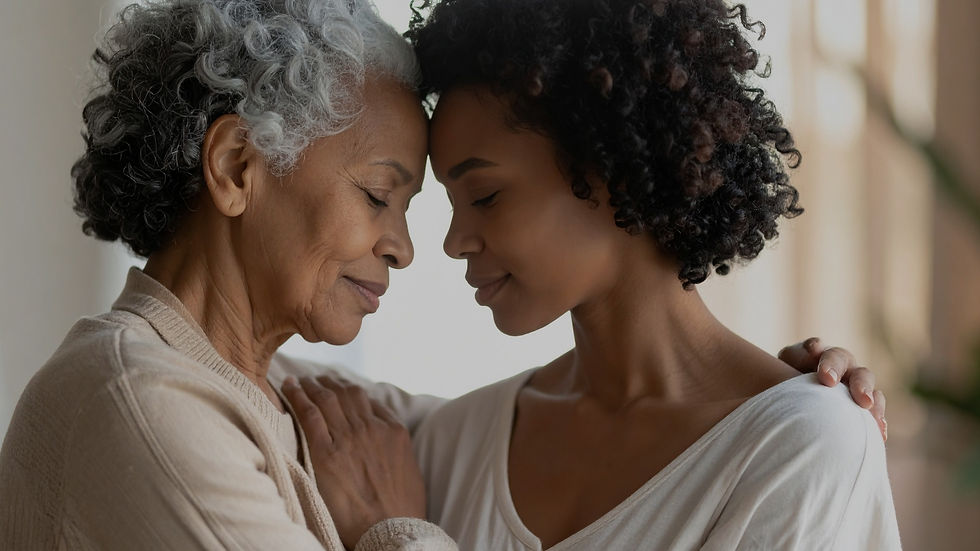
Finding Peace After the Loss of Your Mother
by Sharon Bailey
Losing your mother feels like losing a part of yourself. Whether she was your best friend or your relationship was complicated, the grief is deep, and the guilt can be overwhelming. Did I do enough? Should I have said more? Why didn’t I see the signs? If you didn’t get to say goodbye, or if there were unresolved wounds, know this: She loved you, and still does.
Grief doesn’t follow a straight path, but don’t let it bury you in guilt. Honor her by living with purpose:
Speak her name – Keep her memory alive through stories, traditions, and the love she poured into you.
Let yourself grieve – There is no right way to mourn. Some days will be heavy, others lighter. Allow yourself to feel it all.
Heal what was left undone – If your relationship had struggles, release the regrets. Love was still there, even in the broken places.
Find purpose in pain – Journal, seek therapy, or show up for others the way she would have wanted.
Letting Go with Grace
Letting go doesn’t mean forgetting. It means releasing the weight of guilt, regret and what-ifs. It means forgiving yourself for what you did and didn’t do and choosing to honor her by living fully. Even if your relationship wasn’t perfect, the love was real. Hold on to that, not the pain.
Find Joy after Loss
Joy may feel impossible after such a deep loss, but it will return little by little, in unexpected moments.
Allow joy without guilt – Laugh, dance, and celebrate when you can. Your happiness doesn’t erase your love for her.
Embrace what she loved – If she found joy in music, nature, cooking, or community, immerse yourself in those things.
Create new memories with her in mind – Start traditions that honor her spirit while allowing yourself to grow.
Surround yourself with love – Let your sisters, family, and friends remind you that joy still exists, even in the midst of grief.
Lean on your sisters. When grief feels unbearable, let them hold you up, remind you to eat, to rest, to breathe. Let them help you carry what feels too heavy. But if you find yourself feeling forgotten, if the people who promised to be there have gone silent, or if you have no one to lean on, know that you can always lean on Jesus. He promised never to leave you nor forsake you. Even in your loneliest, quietest moments, His love is steadfast. His presence is real and He will carry you through.
You may never be the same, but don’t let guilt steal the love and joy that surrounds you. She is with you, always.
Dedicated to my Mother, Fay-Joy aka Rudisha.
You were firm, fearless, and deeply loving. You had a heart that gave freely and a spirit that stood tall. You helped everyone, asked for nothing in return and never let anyone take advantage of you. You loved people and loved to serve. Our relationship had its share of tension, but beneath it all, there was love---real, fierce and unwavering. I know you believed in me even when our love looked more like strength than softness and our connection felt more complicated than clear. Your strength, generosity and unapologetic spirit live on in me. Thank you for loving me in the way only you could. I will always carry your legacy with grace, purpose and deep gratitude. Thank you Mama. I will always love you.
Wellness Corner

“Navigating Healthcare as a Woman: How to Advocate for Yourself”
by GodsFavour Guillet, MS, PHE, BSN, RN, NEA-BC, CPXP
What does it mean to navigate healthcare as a woman? Dealing effectively within the healthcare landscape can be challenging. From communicating your feelings and symptoms to your healthcare provider to getting your concerns addressed in a meaningful way, the journey from problem onset to relief has many nuances that you should be aware of. Although it may not seem like it, your healthcare provider took on their role “to help people” and overwhelmingly has honorable intentions. So how do you get them to make good on their oath to “do no harm”?
Mom said, it takes “two to tango” and therefore, it is beneficial that you provide as much information about yourself as is possible. Note, you are the expert of your feelings and you must present a picture that helps them understand what is normal and abnormal for you. Let’s discuss pain as an example.
In 2020, the International Association for the Study of Pain defined pain as the following, “pain is an unpleasant sensory and emotional experience associated with, or resembling that associated with actual or potential damage”. They further explained that there are two categories of pain–acute and chronic.
We all have intermittent aches and pains. Perhaps you slept wrong and your neck hurts, or you lifted a heavy box the wrong way and your back hurts. These pains are expected. Conversely, let’s say you notice a “different” pain that perhaps is new or does not have a precipitating event and it is limiting your ability to function normally. You decide that it needs to be evaluated by your health care provider. As the expert on yourself, you have the responsibility to provide information that allows your healthcare provider to identify an accurate diagnosis or determine what further assessment will be required to make the correct diagnosis and resolve your concern. Here are some things your healthcare provider needs to know:
Your normal activity level (this varies for everyone). Explain how the pain affects your ability to function, including:
Daily tasks
Sleep patterns
Mood or emotional state
Detailed information about the pain, including:
Location – Where exactly is the pain?
Triggers and relief – What causes it to start or stop?
Type of pain – Is it sharp, dull, radiating, burning, or gnawing?
Intensity – Rate it on a scale of 0 to 10 (0 = no pain, 10 = unbearable pain)
This sounds like a lot of information and it is imperative that you truthfully share each piece so that your healthcare provider will be able to successfully put the puzzle together. Consider yourself a highly valued partner in this investigation into your health concern. While we are on the subject of pain and self-advocacy, please take note of these “pain myths”:
1. “Pain is a normal part of aging.” Whatever your age is, pain is a message from your body that something is wrong, and you may have a problem. It is not a norm of getting older. Tell your health care provider so you can be treated.
2. “If I tell my healthcare provider, I will be labeled as a complainer or drug-seeker.” We do not wish to be viewed as being whiny. Some of us will experience prolonged periods of pain before going to the hospital because we are afraid of being seen as drug seeking. Do not be afraid to talk about your pain and do not allow healthcare providers’ attitude or misunderstanding of your condition leave you with untreated pain. The truth is that not treating your pain reduces the quality of your life and can lead to activity impairment, anxiety and depression.
3. ”Pain medication leads to addiction.” As a healthcare provider myself I heard this countless times as I encouraged my patients to take needed and appropriately prescribed pain medication. According to the Nation Institute of Drug Abuse, 88% to 92% of opioid users will be addiction free. “Addiction or misuse is defined as compulsive, difficult to control, continued drug use despite negative consequences like losing your job or family problems.” Talk to you healthcare provider about your pain treatment options and your individual risk factors as you make informed decisions about taking opioids.
4. “Alternative treatments don’t work.” In short, THEY WORK! Some examples are breathing techniques, meditation, essential oils, a pain healing garden, yoga, stretching, dieting, mindfulness, massage and acupuncture. Do your research so you can be informed about what may work best for you.
Negotiating your healthcare needs requires you to have grit at a moment in your life where you need more support. You will want to feel validated enough to clearly ask for help. In your life, you are probably someone who is very giving to others. Accept that this is your time to be on the receiving end of care. Here are some difficulties or biases that you may face as you try to get the best health care. Be aware that if you are: a woman, a person of color/BIPOC (Black, Indigenous, person of color), a member of the LGBTQIA+ community, your pain may sometimes be taken less seriously, discounted entirely or ignored. If you add to the list certain conditions such as Sickle Cell Disease, back or stomach pain, you may work exceedingly hard to have your health concerns mitigated.
What should you do?
Describe the feelings, symptoms and additional conditions as clearly as possible; tell the RAW story and ask what is available to prevent the pain from worsening
Learn about your condition (use reputable sources)
Be prepared (write down questions and important information)
Keep notes of your medical history and medications (including from other providers)
Include a support person (friend, family member or companion)
Find a specialist (use reviews, referrals)
Get a second opinion
Resist the urge to accept being ignored, disregarded or dismissed
Understand that it is your healthcare provider’s responsibility to help you and that you are not bothering anyone.
The goal is identification and treatment of your health concern. Do not worry about oversharing how you feel with your healthcare provider. They are there to listen and help you in any way possible. No one should have to live with healthcare concerns, like pain, and if you are treated appropriately, then you have successfully navigated your healthcare journey!
Bibliography
Protecting Your Peace

Everyday Self-Care Tools for Black Women
by Sharon Bailey
Black women have long been the backbone of families, movements and communities—leading, loving and laboring in powerful ways. But while holding space for others, too often we forget to hold space for ourselves. In a world that frequently demands our strength, protecting your peace is not just important— it’s essential. Daily self-care is how we reclaim our time, our health and our joy.
Self-care is more than spa days and bubble baths—it’s the quiet discipline of making yourself a priority. It’s saying “yes” to your healing and “no” to anything that disrupts your peace. It’s knowing that rest, reflection and nourishment are not luxuries; they are your right.
Start Your Day Grounded-How you begin your morning can shape your entire day. Create a routine that centers you in peace. That might mean: spending time in prayer, silence and deep breathing, saying affirmations like “I am enough just as I am” or listening to an empowering playlist while getting ready for work or school. Even five intentional minutes can set a tone of calm and confidence.
Honor Your Emotions- Give yourself permission to feel fully with out judgment. Journaling is a powerful tool for this. Try starting and ending your day by writing down: what you’re feeling and why, what you need more or less of and one thing you are grateful for. Journaling helps you process your emotions, identify patterns and stay rooted in truth.
As a side note, Sis, it’s ok to love Jesus AND have a therapist! Faith and therapy go hand in hand. There is no shame in seeking help—healing is your birthright. Loving Jesus and having a therapist can complement each other beautifully by creating a holistic approach to mental and spiritual well-being. Therapy gives voice to your pain and tools for healing; faith reminds you of your worth and your purpose. Embracing both can help you protect your peace and find balance. You’re never alone and there is strength in seeking support.
Move and Nourish Your Body-Your body carries you through the world everyday. Movement doesn’t have to be intense to be meaningful. It can be: a walk outside, dancing to your favorite song, a short yoga or breathing video on YouTube. Couple movement with nourishment—hydration, balanced meals and moments of stillness. Feeding your body is feeding your peace.
Set Boundaries Without Guilt: Black women are often expected to be everything to everyone. Saying “no” is a powerful act of self-love. Protect your peace by: setting limits on your availability (even to loved ones), stepping away from toxic conversations or environments, and being unapologetic about needing rest or time alone. Boundaries aren’t walls—they’re bridges to healthier relationships with yourself and others.
Create an Evening Wind-Down: Your night routine is just as important as your morning routine. Create a ritual that helps you release the day and rest well. Try a warm bath with calming music or turning off screens 30 minutes before sleep, or using lavender and eucalyptus essential oils to soothe your mind. Rest is where you restore your power.
Connect with Community: We don’t have to carry it all alone. Create or nurture relationships with people who see you, support you and pour into you. Whether it’s a text group chat, a virtual support circle or your therapist. Community care strengthens self-care.. We weren’t meant to go through life alone. Community, like self-care, is a sacred resource.
Scripture Reflection

by Minister Nedelka F. Prescod | Musician | Educator |
Consultant
“9 Two are better than one, because they have a good return for their labor:
10 If either of them falls down, one can help the other up.
But pity anyone who falls and has no one to help them up” Ecclesiastes 4:9-10 (NIV)
For reasons, agendas and legacies not founded or grounded in sacredly held Ancestral ways of communal being, we now live in a society that celebrates rugged individualism. Instead of embracing powerful and beautiful traditions of effective communal living, we find ourselves living by, and inherently upholding, an existence whose mantra is, “pull yourself up by your own bootstraps.” We could go “on and on” like Badu naming the reasons why and how we arrived at such individualism. We can call the role and recite the litany of historical facts and their ripple effects on how and why we became so individualized.
We can also begin resonating with the Holy Spirit in the wisdom of our Ancestral traditions found in the inspired words of the Holy Writ.
The ninth and tenth verses of the fourth chapter of Ecclesiastes (4: 9 - 10) is a wonderful scripture in the way it clearly offers a simple and practical solution for humanity, for whatever year it may be.
“Two are better than one, because they have a good return for their labor.”
It is believed that the book of Ecclesiastes is written by one of David’s (the giant slayer who became the king of the Israelites) sons who wrote down the words of a “Qohelet.” A “qohelet” being one who gathers people together to teach. Gathers. People together. To teach them.
One of the wonders of the Bible is the way it holds layers of meaning and relevance. That one word, placed in the right context, speaks to realities, then and now, in the language of the message it is giving. For instance, here the teacher, the qohelet, gathers people to explain, and even demonstrate, why more than one gathered together is important.
“if either of them falls down, one can help the other up. But pity anyone who falls and has no one to help them up.”
Chapter four is telling of a strong time holding harsh realities. A time of oppression where evil inspires pursuits of vain endeavors and for material acquisitions. A meaningless use of time and life by one who had no family or inheritors of the material things, but yet “toiled”, failing to live an enjoyable life. The wisdom gleaned from such a reality is that “two are better than one, because they have a good return for their labor”– together.
As I write, oppression persists with changing facades, and people–humanity–us–we continue to believe that individualism will bring us into the prosperity we desire. As I bring such reflections to a close, I ask that you remember the wisdom of Ecclesiastes, held in the lyrics of the song, “No Man is an Island: as recorded by Dennis Brown: Click Here
“No [one] is an island.
No, no [one] stands alone.
Treat each [one] as your brother
And remember... each [one’s] dream as your own.
Now we need one another.
And we all need to try to be friends.
You can't live in this world all by yourself.
No, no, no. You can't make it alone.
And just as sure as you try to make it by yourself.
You're going to wake up and find
You're going to need somebody else.
No [one] is an island.
No [one] stands alone.”
Final Word: You Are Not Alone

Sis, no matter what you are facing, remember this:
You are strong, You are loved and You are never alone.
We lift as we climb--so let’s keep climbing together.
“May the Lord watch between me and thee while we’re absent one from another.”
Until Next Time, Blessings!
-Shay

Comments